

| |


The following picture was on one of the Madison County penny postcards; while the date is unknown it could have been as shown on the penny above, 1914. Other penny postcards may be seen at: (http://www.rootsweb.com/~usgenweb/special/ppcs/ppcs.html)

Circa 1922 - Frank Falkenberry, Sr., and Jr. in their back yard at the corner of Stevens Avenue and Fourth Street


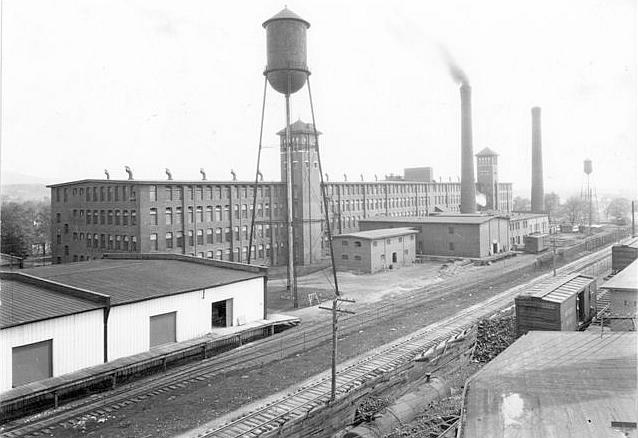
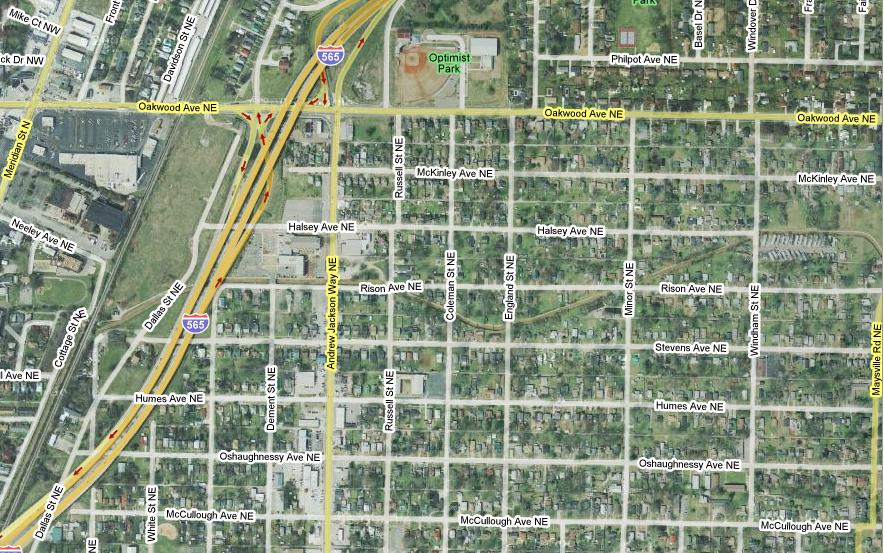
On the left is a picture of the Dallas and Lincoln Mill Villages from yesteryear, and on the right is a modern-day view of the same general area. The large empty green patch is the site of Dallas Mill. Please click on these small pictures to see larger versions.
 |
 |
You may also click on the image below to see an expanded view of the area today. Please note that this view is oriented so that North is at the top of the page. These images are from the Google maps website.
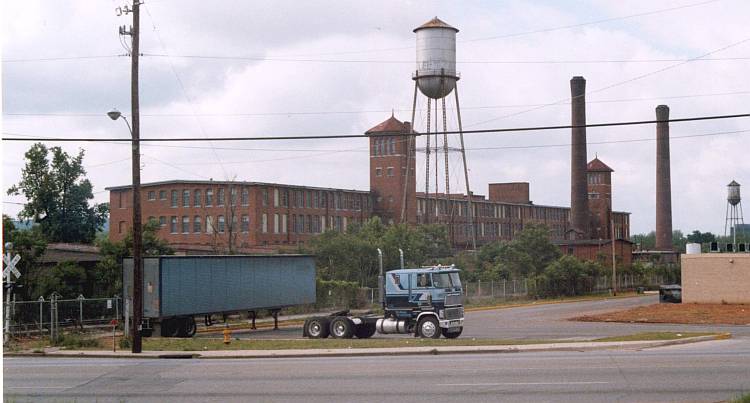
Below is a photo of Dallas Mill and Lincoln Mill and the mill villages, looking toward the east.


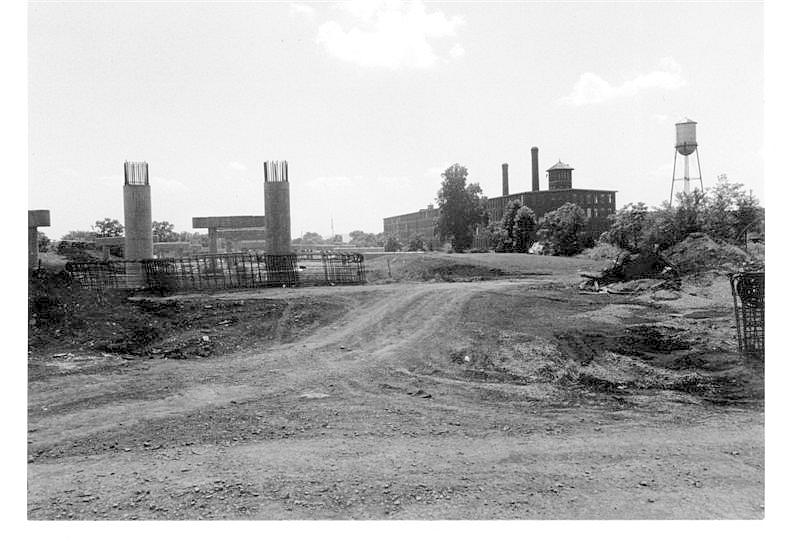
Circa 1990 - The picture below was taken from Oakwood Avenue and shows pillars constructed to support a portion of I-565; note Dallas Mill in the background.
The unoccupied Dallas Mill building was destroyed by fire on 24 July 1991. Below is a picture during the fire and three pictures of the building in ruins.

The unoccupied Dallas Mill burning on 24 July 1991


Please click here for a gallery of photos of the mill after the fire.
And click here to see additional photos provided by Lance George that show the mill after the fire as well as damage to Lincoln Mill. (added January 28, 2012)
One of our readers, David P. Michael, provided the following information about Dallas Mill.
(Editor's note: I was unable to contact Mr. Michael to learn how he came to know so much about the mill and how he had access. The information is fascinating and certainly previously unknown.)
The demolition of the adjacent cotton warehouses were demolished several years before the fire. The timbers and brick were harvested and the resale was estimated at somewhere between 280k and 400k. Prior to the arson, the building was in negotiation to be razed for the timber and brick. The bid for the brick was .30 each. This was ironic since the building was purchased from the family that was leasing to Genesco for $480k. The brick in the old Dallas mill were "Chicago Brick" and were sold for $300.00 per 1000 after cleaning.
The Dallas Mill was a wonderful old building. Did you know that you could actually lift a manhole cover in the basement and walk underground and exit through a manhole in front of the old First National Bank at Big Springs? The well in the basement was approximately 20' in diameter and 80' in depth. The walls were slip formed concrete and were constructed in 10' lifts. The walls were poured above ground and the shoring was burned underneath allowing the walls to slip down into the excavation. There is an old family in Huntsville by the name of Powell. I recall one of the younger members was called Dudley Powell. Dudley is now in his late 60's or early 70's. In the early 1980's I had the pleasure of meeting his grandfather. (then in his late 70s or early 80's) I can't recall his name but he lived off of Echols. He told me that his grandfather was the superintendent of construction of the well. He recounted the story to me as his grandfather had told to him. The well was hand excavated with the labor of ex-slaves. This was in the late 1880s which sounded feasible. He said that accidents were frequent and death of workers was common and expected. The manual labor was expendable. If you can confirm this I would like to know.
I have enjoyed the recollection and your web-site has brought many happy and interesting memories. More trivia, during the early years probably in the 20's or 30's there was an agreement with the City of Huntsville that had to do with Mineral rights or water rights. The City would provide water to the mill at no cost. I speculate that the land that the city well is located adjacent was deeded to the city in exchange for unlimited usage. I do know that the main that supplied the mill from the city was approximately 6" in diameter and up until about 1986 there was no meter installed. The subterranean architecture of the Mill was unbelievable. There were caverns, tunnels and caves located under the basement. Some of these tunnels were perfectly round and were approximately 6' in diameter and ran for miles under the city. Some may have been man made. The air circulation systems in the mill were tapped into these caverns. The tunnels were also used for installation of water lines and later electrical. I remember going into one of the tunnels and seeing a broken water main. It had probably been broken for years. The leakage filled the lower tunnels and made them inaccessible. I believe that the city became aware of the leakage around 1988 and terminated service to the building which created problems with the sprinkler and fire protection systems. It was about this time that the building lost its fire protection. There were many contributing factors to the loss of this building. They all compounded upon themselves. If you have contacts with any of the mill maintenance staff, I would like to confirm the above speculations. If you know when the Mill filled the reservoir that may be a starting point for dates. I do know that the city well was probably drilled in the 1950's and that is after the mill closed.


Superintendents' and Overseers' Homes, Village of Dallas, Date Unknown. Oakwood Avenue?

Unfortunately, we are unable to identify the children in this photo; some are probably relatives or possibly all siblings. I wonder if any of them were working in the mill? (See the children workers on this page.) Note that the children are barefooted, a common thing for us children to do in warm weather.
(Photo courtesy of Solomon Miller)

Editor's note, October 25, 2007: We heard from Brian Hogan who shared the following missing information:
"I thought I would give you an update on my quest to confirm that the 'old red school house building behind Rison School' was called Oakwood, the residence of W.H.Moore.
I have reviewed Chancery Court files, mortgage records, and G.W.Jones & Co. abstracts in the Madison County Court Records on the third floor of the Huntsville Public Library and can state with absolute certainty that that "old red school house building " was Moore's home, Oakwood.
I can not document that Oakwood Ave. was named after it but the coincidence cannot be ignored. I assert, without proof, that it was.
I also discovered a plat map done in 1945 that shows the location of the building, approximately 100 yards north of the Rison School, and fronting on what was then Elliott Street. (I think that's Withers Street today.) When time permits I intend to walk the area to pin point its location.
One thing confuses me...one of the photos on your website shows a single story duplex connected to one wing of the house. This does not appear on the plat map. Possibly because that structure was added after 1945, or had been moved from that location before 1945?
(Editor's update February 7, 2008: In response to the above query, our friend, Sara Ann Certain Hymer, said: "I know the addition to the old red schoolhouse, in what we called the grove, was there when I was a small child and I was born in 1928. The Chisams lived there - Mrs. Chisam and three sons or at least one of them who was Billie and Charles Chisam's father. I used to play with Billie because she was about my age. At the same time, the Wallaces and the Kings lived in the big house. After the Wallaces moved out, the Hawkins moved in. I don't know how long the Hawkins lived there but it was while I was growing up.")
As you know the current owner of that duplex could you inquire about this? I strongly suspect that the structure was moved as it now front on Withers St. as extended north.
(Editor's note: The owner of the duplex no longer lives at that site. It is my understanding that the wing now sits in the same location as originally added to the brick structure; the date it was added is not known.)
One other point...there was a lengthy Chancery Court case (#1557) in which W.H.Moore, as a Commissioner, and his children were involved which was resolved in 1887 and a decree rendered that directed William H.Moore to sell the lands involved. He did not, for reasons unknown, comply with that decree before he died in August, 1891. A new Commissioner was assigned to carry out the terms of the decree. It was not until November, 1899 that the property was sold, at public auction, to the Dallas Manufacturing Co., for $12,000 cash. The property consisted of two tracts, one of 40 and 65/100, and the other of 27 acres, for a total of 67 and 65/100 acres.
Thus it's certain that W.H.Moore had not given the "old red school house" to Dallas Mills.
I have a couple of other questions...what happened to that building? Someone told me it burned down but didn't know when that occurred. Another told me it had been demolished at the same time as the Rison School, in 1969. Can you enlighten me?
(Editor's note: Second hand information is that the owner of the brick portion of the old red schoolhouse demolished it to make way for the impending portion of I-565; the exact date is unknown. We do know that Rison School was torn down in the early 1990s in preparation for I-565.)
A red schoolhouse story:
I remember a story told to me by my daddy, Earl (Pappy) Schrimsher. He and a friend (whose name I won't reveal!) attended school in the red
schoolhouse. Before school time on a cold winter morning , they "relieved" themselves into the pot-bellied stove. When the teacher arrived and started a
fire, the stench was so bad that the teacher opened the windows and sent the kids outside to play until the odor subsided. Daddy laughed when telling the
story and said, "Don't tell Ronnie and Bobby about it!" He said that because my brothers could get into trouble on their own without any suggestions!
~Ann Schrimsher Franklin
Another red schoolhouse story:
My family lived in the two story section of the red school house somewhere around 1954-55 when I was in the 1st or 2nd grade at Rison School. My parents, Raymond and Zettie (Allen), along with my sister Larelle and myself, lived there. There was an old iron spiral staircase going to the second floor. The ceilings were very high, probably not more than usual but I was a little fellow then. Marie Owens and her husband (I think his name was Jeff) and their son Mike lived next door for awhile. I remember the big coal stove and having to go out and fill the coal bucket before bedtime.
~Glenn Swaim
 |
 |
 |


Bobbin cleaner & utility hand: ??
Card tender: ??
Conveyer man: Keeps cotton fed on conveyer, from opening room to card room.
Drawing section and oiler: Takes rope of cotton off machines; keeps machines oiled.
Drawing tender: When roping cans get full, tender takes to spinning room.
Fixer on frames: Maintains machinery.
Grinder: Keeps the cards ground, removing impurities in the cotton.
Intermediate Tender: ??
Lip Weigher: ??
Opening room: Where the bales of cotton are opened and fed into ducts into card room.
Opening room hand: Someone who works in the opening room.
Roving layer: ??
Scrubber: Keeps blowers and machinery clean.
Section on drawing: ??
Slubber tender: ??
Spare hand: Fills in when someone is out.
Speeder tender: ??
Temp job rolling boxes: ??
Yarn and roving weigher: Keeps the weight consistent.

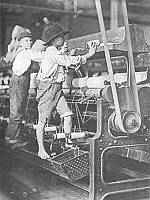 Did you notice that there are only males in these pictures? Does that mean that work as fixers and doffers could only be
performed by males? Did the work require greater strength than that possessed by women? Does that mean that
male children were considered to be stronger than women, especially girls?
Did you notice that there are only males in these pictures? Does that mean that work as fixers and doffers could only be
performed by males? Did the work require greater strength than that possessed by women? Does that mean that
male children were considered to be stronger than women, especially girls?
We learned from Thurman Frasier, who worked in cotton mills, that the reason women didn’t work as loom fixers and doffers in the weave room is that the equipment was too heavy for them to operate. He had no idea as to how the young boys would have been able to operate the equipment unless they were given jobs as helpers.
Thurman said that in the 1960s a few women were trained as loom fixers in the weave room. In the spinning room, fixers and doffers were both men and women.
(Editor’s note:
In a recent conversation with Sally, I learned of a compassionate deed done by the leaders of Dallas Mill following the death of her father from an injury he sustained while working at the mill; Sally was a baby.
At my request, Sally shared the story below. I thought that it was particularly noteworthy because one’s impression could easily be that the mill leaders were unfeeling so to learn otherwise is touching and is a story that needs to be told.
While this is the only such incident we know about, perhaps you know of others. If you do, please share them with us at http://www.rison-dallas.com.)
 This is Lionel Certain's graduation picture from St. Mary's Catholic School on Holmes Avenue.
|
In October 1928, my dad, Lionel Certain, who had gone to work at Dallas Mill, was walking down an aisle in the mill when a bobbin fell from a top rack and hit him on his forehead at his hairline; it did not break the skin.
He developed a headache and told his supervisor (who was his brother, Clarence) what had happened and Clarence told him to go home. When he went to the doctor the next day because of the severe headache, the doctor said he had a blood clot on his brain. From that time on he suffered severe headaches and had two operations to remove pieces of his skull to relieve pressure on his brain. He died on March 3, 1929, at Huntsville Hospital after the second operation; he was 19 years old; I was 5 1/2 months old. I would like to know if anyone else died due to an accident in the mill. The mill set up a trust fund for me at Rison Bank, the money from which could be used for my benefit with approval of the bank trustees. I don't know but I believe it was used for extraordinary expenses like doctor, dentist, etc. Also, when Rison School was operating on a 7 month school year, one could pay and go the additional 2 months and so I attended for the full 9 months made possible by the trust. When I graduated from high school there was enough money to pay my tuition for a course at the Nashville Business College in Nashville, TN. I don't know the original value of the trust fund but even a little money was a lot during that time.
|

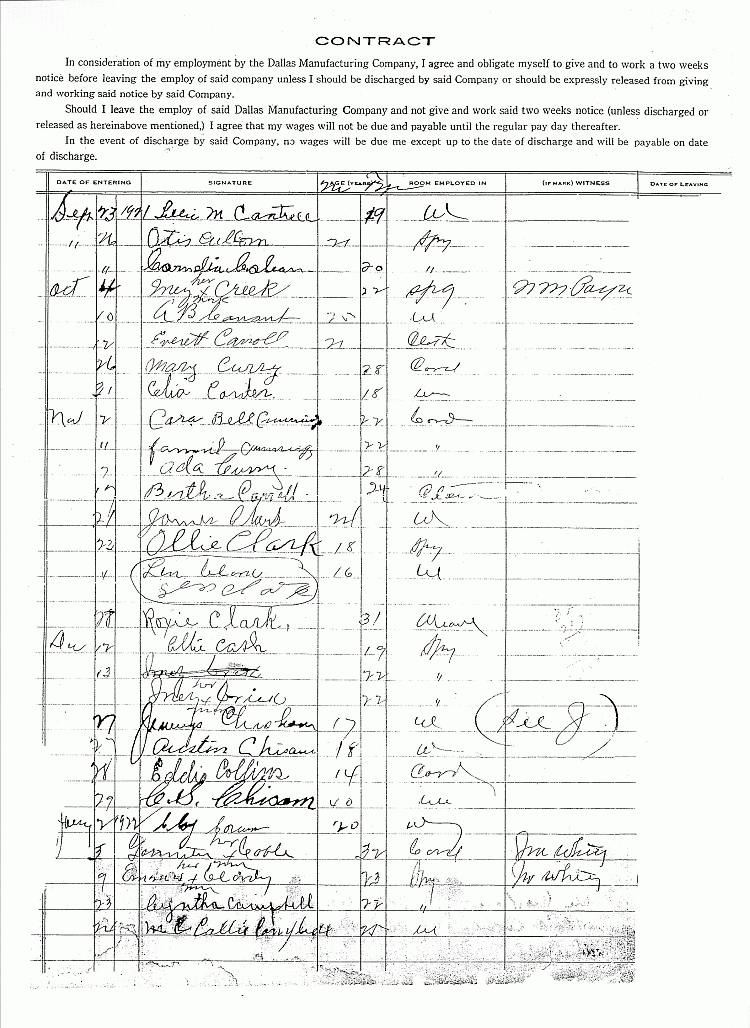
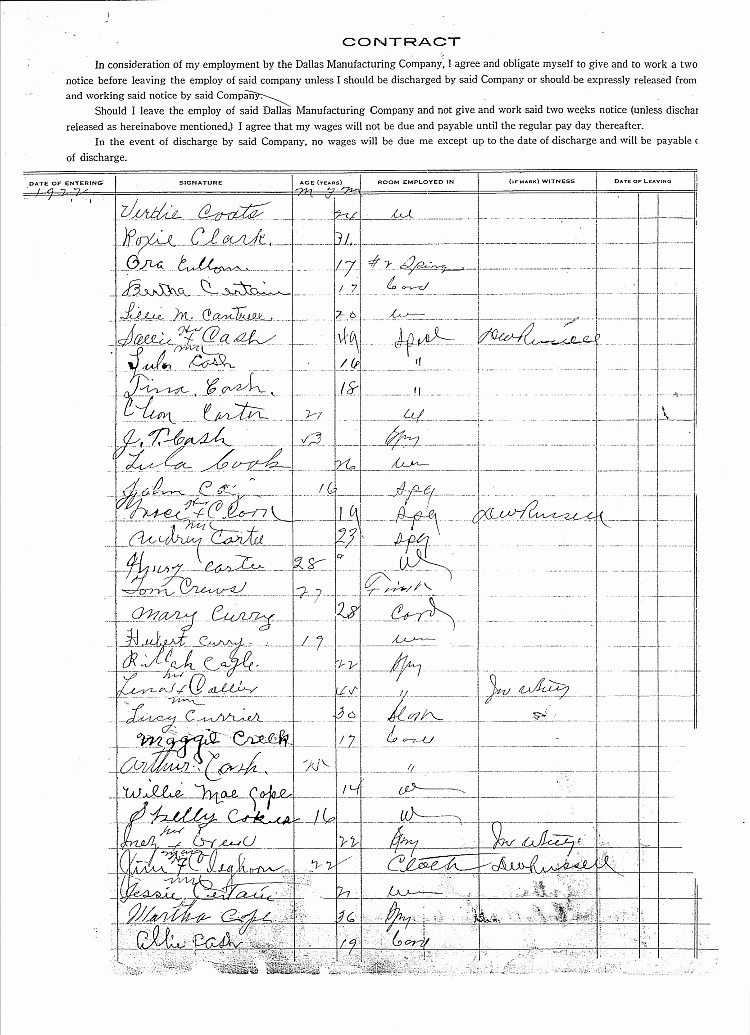
It was the children who suffered the most. There were no child labor laws and many families were forced to put their children to work in order to survive.
Mill owners actively encouraged the use of children as a "prime source of labor" and Huntsville newspapers praised the mills for teaching the children "work ethics."
In Alabama, almost one out of every four mill workers was a child.
Please click here to read the complete story.
New Law Will Compel 300 Children to Quit Local Mills
(Used by permission of Old Huntsville magazine.)
Huntsville, April 8 - The new child labor law adopted by the Alabama legislature will not affect any of the cotton mills in Huntsville. The report had been circulated that the operation of the law would compel 300 children to quit working in the Dallas mill, but this is emphatically denied by W.R. Rison, general manager of the Dallas company.
Mr. Rison states that it is against the rules of the company to employ any child under 12 years of age, and if there are any younger operatives, their ages have been misrepresented by their parents.
Other representatives of the mills praised the mills' policy in providing work for children who would otherwise become vagrants and a nuisance to peaceful society. The spokesman also said that many of the children alleged to be under the lawful employment age of twelve were merely stunted in their growth, giving a false impression to people investigating mill conditions.
Mills in other states have overcome this problem by having potential employees swear they are at least twelve years of age, thereby relieving the mills of any legal responsibility.
Factories in Alabama are expected to implement the same policy.
If you have trouble playing the clip, here is a direct link.
It's not surprising then that so many of our people either died an early death with lung problems or suffered with breathing problems the rest of their lives. One wonders how they were able to breathe, or see, at all in that environment.
While it is sad to see the working conditions that our loved ones endured, it makes us proud to understand that they were willing to do whatever necessary to support their families.


(Note: Click Here to see a closeup view of the girl's basketball team)


You may return to Page 2 of the History of Rison and Dallas Mill by clicking here.
You may go on to Page 4 of the History of Rison and Dallas Mill by clicking here.
| |